 11
11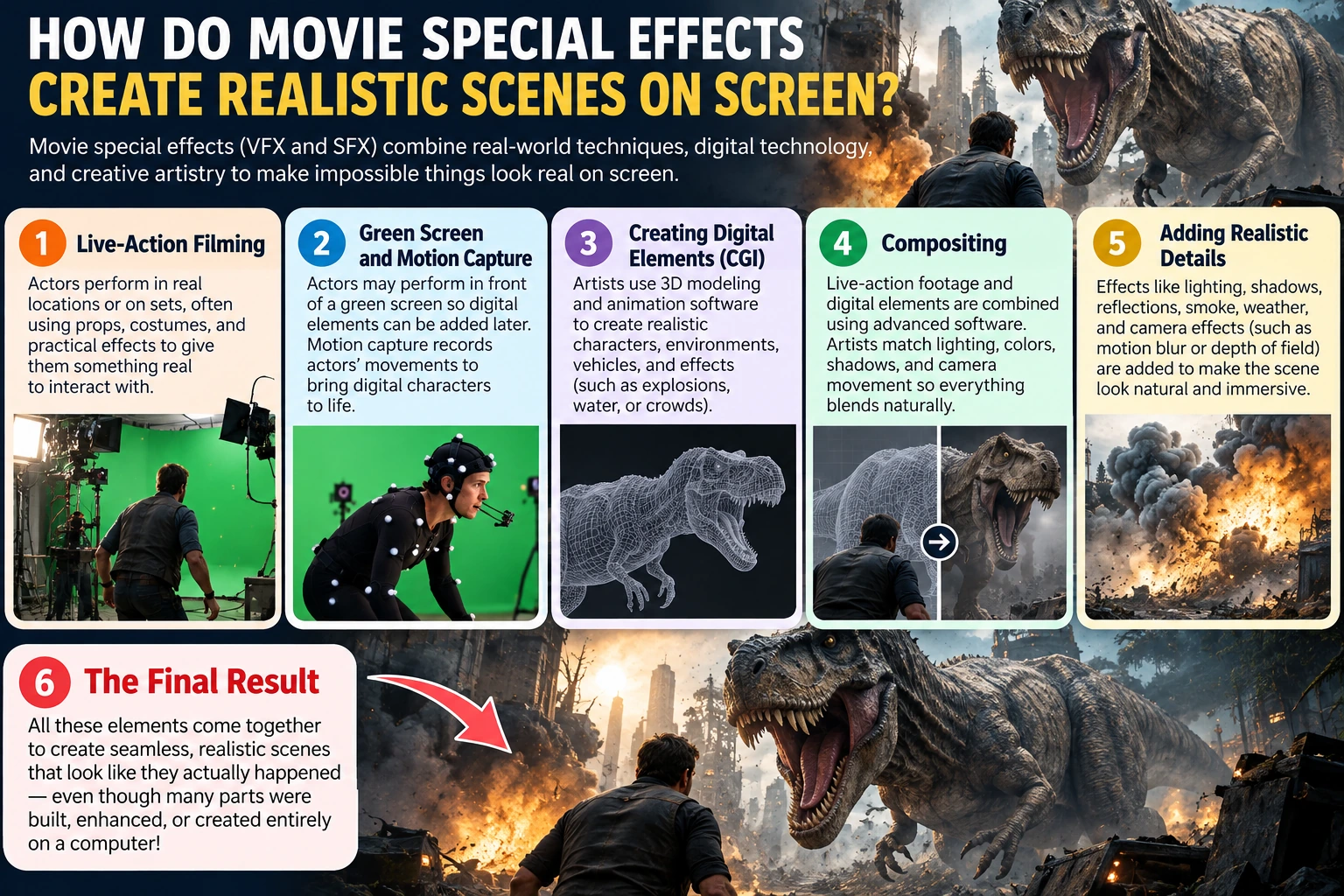
Movie special effects have transformed the way filmmakers tell stories, allowing audiences to experience everything from spectacular space battles to realistic historical settings. Scenes that appear impossible to create in real life are often produced through a combination of practical techniques, computer-generated imagery, advanced cameras, and careful sound design. Whether a film features a massive explosion or a lifelike fantasy creature, special effects help bring the director’s vision to the screen. Understanding how these techniques work reveals the creativity and technology behind modern filmmaking.
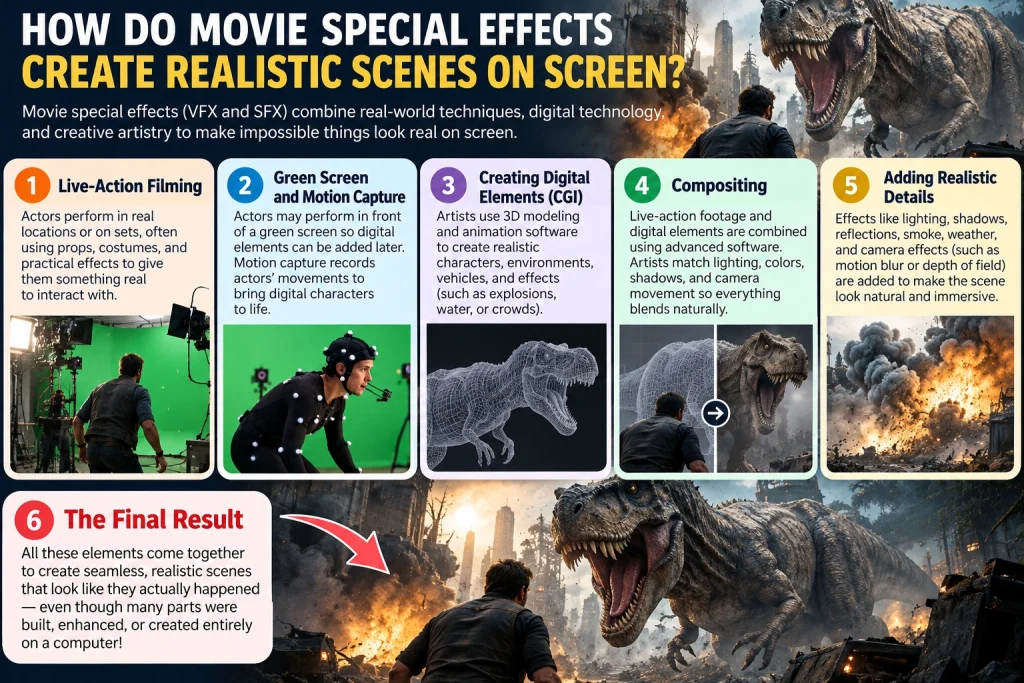
Movie special effects are techniques used to create visual or physical elements that would be difficult, dangerous, expensive, or impossible to capture through ordinary filming.
They generally fall into two broad categories: practical effects and visual effects. Practical effects are created physically during production, while visual effects are created or modified digitally, often during post-production.
Many modern films combine both approaches. A physical set might provide realistic lighting and shadows, while digital tools expand the environment or add details that would otherwise be impossible to film.
Practical effects involve physical techniques performed on a film set. Examples include makeup, prosthetics, miniature models, controlled explosions, artificial rain, and mechanical props.
For instance, filmmakers may use silicone prosthetics and carefully applied makeup to create realistic injuries or aging effects. Miniature buildings and vehicles can also be filmed to represent larger objects when camera angles, lighting, and scale are carefully controlled.
Practical effects can provide genuine textures and physical interactions that actors can respond to naturally. They remain useful even in productions that rely heavily on digital technology.
Computer-generated imagery, commonly called CGI, allows filmmakers to create digital characters, environments, objects, and effects.
CGI is used for everything from imaginary creatures to enormous cityscapes and futuristic vehicles. Artists build three-dimensional models, apply textures, create digital lighting, and animate objects to make them appear believable.
To achieve realistic results, digital elements must match the filmed footage. Their lighting, shadows, reflections, perspective, and movement need to correspond to the environment.
When these details are handled carefully, audiences can accept a digitally created object as part of the same world as the live-action characters.
Motion capture records the movements of actors and uses that information to animate digital characters. Depending on the technique, cameras and sensors can track body movements, facial expressions, or both.
Animators use the captured performance as a foundation and refine the character’s movements to suit the scene.
This technology allows filmmakers to create digital characters that communicate through recognizable gestures, expressions, and body language. However, motion capture alone does not automatically produce a realistic character. Artists must also consider facial details, eye movement, skin appearance, and how the character interacts with the environment.
Green-screen technology allows filmmakers to replace a colored background with another image or digital environment. The process, known as chroma keying, separates the subject from the background so that different visual elements can be combined.
Actors can perform on a controlled studio set while the final scene depicts a distant planet, a busy city, or a dangerous landscape.
For the result to look convincing, filmmakers must match the background’s lighting, camera perspective, focus, and color. Shadows and reflections may also need to be recreated.
Green screens offer considerable flexibility, although actors sometimes need additional direction to imagine environments that are not physically present.
Even highly detailed digital effects can look artificial when lighting and camera work do not match the scene.
Cinematographers plan the direction, intensity, and color of light to establish the correct atmosphere. Visual-effects teams then reproduce those conditions when creating digital elements.
Camera movement, lens choice, perspective, and depth of field also influence how audiences perceive scale and distance.
For example, a digital creature standing beside an actor must appear to occupy the same physical space. Consistent shadows, proportions, and camera movement help create that illusion.
Realistic scenes depend on sound as well as images. Sound designers create or record footsteps, wind, machinery, impacts, explosions, and environmental ambience.
Sometimes, everyday objects are recorded to produce unexpected sounds. A combination of layered recordings can create a unique sound for a fictional creature or futuristic machine.
The timing and intensity of sound are equally important. A visual impact without an appropriate audio cue may feel less convincing, while carefully synchronized sound can make an action sequence more immersive.
During post-production, editors and visual-effects artists combine footage, digital elements, sound, and color adjustments into a coherent final scene.
Color grading helps footage from different cameras or lighting conditions appear consistent. Compositing brings separate visual layers together, while digital cleanup removes unwanted objects or corrects minor imperfections.
The final result depends on coordination between actors, directors, cinematographers, sound designers, editors, and visual-effects specialists.