
 11
11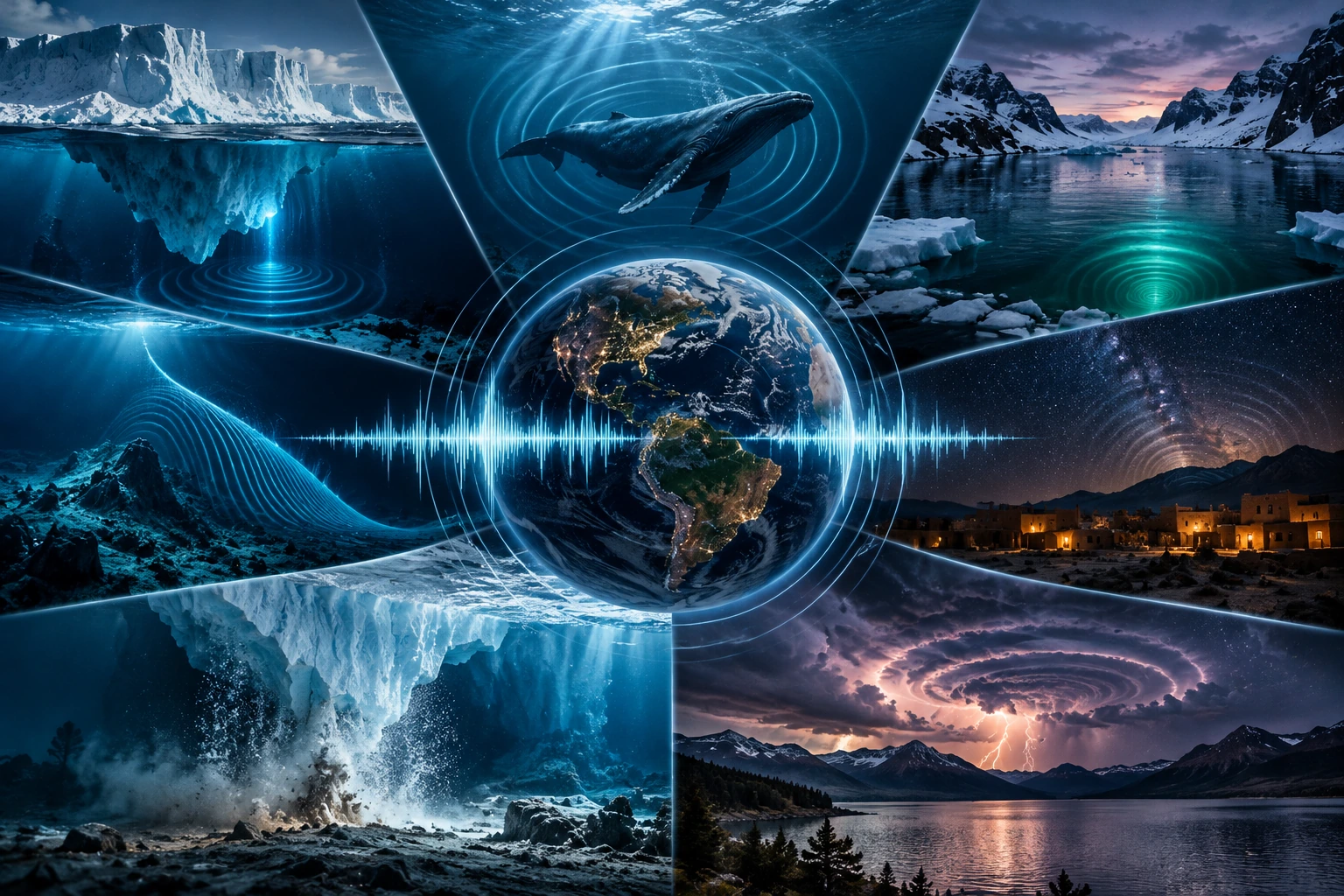
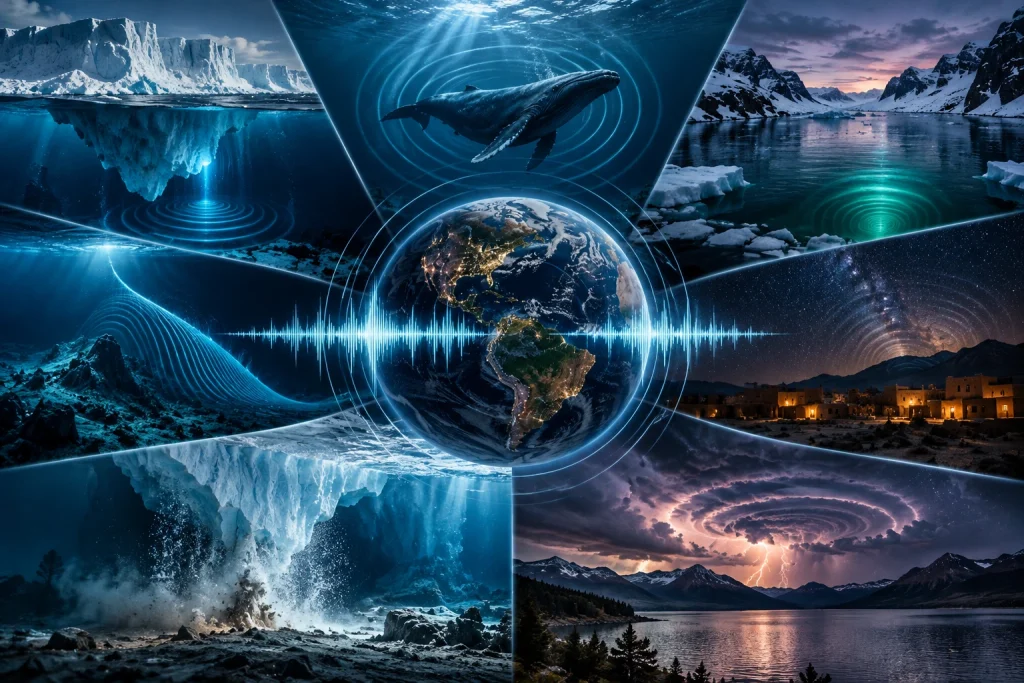
Our planet is full of unusual sounds, from deep ocean booms to strange humming noises heard in remote locations. Some have inspired frightening stories, while others have become fascinating subjects of scientific research. Although certain sounds initially seem impossible to explain, scientists often discover that they are connected to natural processes, animals, weather, or human activity. Exploring these mysterious recordings reveals how much there is still to learn about the world around us.
In 1997, underwater listening equipment operated by the U.S. National Oceanic and Atmospheric Administration (NOAA) detected an exceptionally powerful, low-frequency sound in the southern Pacific Ocean. Researchers nicknamed it the Bloop.
Its unusual intensity attracted public attention, with some people speculating that it might have come from an unknown sea creature. However, scientists later found that its acoustic characteristics were consistent with sounds produced by large icebergs cracking and fracturing.
The Bloop became a famous example of how underwater recordings can sound mysterious when researchers do not initially know their source. It also demonstrated the value of ocean-monitoring systems for studying remote natural events.
Some residents of Taos, New Mexico, have reported hearing a persistent, low-frequency humming sound. Similar reports have emerged from other places around the world, making the phenomenon known as the Hum a subject of continuing interest.
Researchers have investigated possible explanations, including industrial equipment, transportation noise, environmental sound, and the way people perceive low-frequency vibrations.
One challenge is that not everyone can hear the reported hum, and investigators have not identified one confirmed source that explains every case. Different reports may have different causes.
The Taos Hum illustrates how difficult it can be to investigate a sound that is faint, inconsistent, and not always detectable with ordinary recording equipment.
Another mysterious underwater recording is known as the Upsweep. It was detected by ocean monitoring systems in the Pacific during the 1990s and consists of a series of rising tonal sounds.
The sound attracted scientific attention because it was repeated and appeared to vary with the seasons. Researchers have considered natural sources, including volcanic activity, as possible explanations.
Its precise origin has not been conclusively established. The Upsweep remains an interesting example of how underwater microphones can reveal acoustic patterns that are difficult to investigate directly because they originate far from human observers.
Frozen environments can produce surprising noises. When ice expands, contracts, cracks, or fractures, it can generate sharp bangs, whistles, groans, and deep booming sounds.
These noises occur because temperature changes and mechanical stresses cause ice to move or break. The sound may travel across a frozen lake, creating the impression that it is coming from a distant or unknown source.
Scientists study these acoustic events to understand ice behavior and environmental conditions. Although the sounds may appear mysterious to someone hearing them for the first time, they can often be explained by the physical properties of ice.
Volcanoes can produce a remarkable variety of sounds, including low rumbles, explosive booms, and prolonged roaring noises. These sounds may result from moving magma, escaping gases, explosions, and interactions between volcanic activity and the surrounding environment.
Researchers use seismic instruments, microphones, and other monitoring equipment to investigate volcanic behavior. Sound alone cannot reliably predict an eruption, but acoustic measurements can contribute to a broader understanding of activity when combined with other scientific observations.
The unusual noises produced by volcanoes demonstrate the enormous energy involved in geological processes.
Certain sand dunes produce loud humming, booming, or musical sounds when sand grains slide down their slopes. This phenomenon is often called singing or booming sand.
Researchers have investigated how the size, shape, dryness, and movement of sand grains influence the sound. Under suitable conditions, large groups of grains move together and create vibrations that produce a surprisingly powerful acoustic effect.
Not every dune sings, and the exact characteristics vary by location. These natural sounds show how ordinary materials can create extraordinary acoustic experiences under specific conditions.
Space is often described as silent because sound waves cannot travel through the near-perfect vacuum between planets in the same way they travel through air.
However, spacecraft can detect radio waves, plasma waves, and other electromagnetic or particle-related signals from space environments. Scientists can convert certain measurements into audible representations through a process called sonification.
The resulting recordings may sound like whistles, clicks, crackles, or eerie tones. These are not necessarily sounds that a person would hear directly in space; they are audio representations of scientific measurements.
Such recordings help researchers investigate planetary magnetic fields, solar activity, and interactions between charged particles.
Unusual sounds can provide clues about environmental changes, geological processes, animal behavior, and human-made noise. Scientists investigate them by comparing recordings, checking instruments, studying surrounding conditions, and collecting additional measurements.
An important part of this process is separating verified evidence from speculation. A sound that initially seems unexplained is not necessarily supernatural or evidence of an unknown creature.